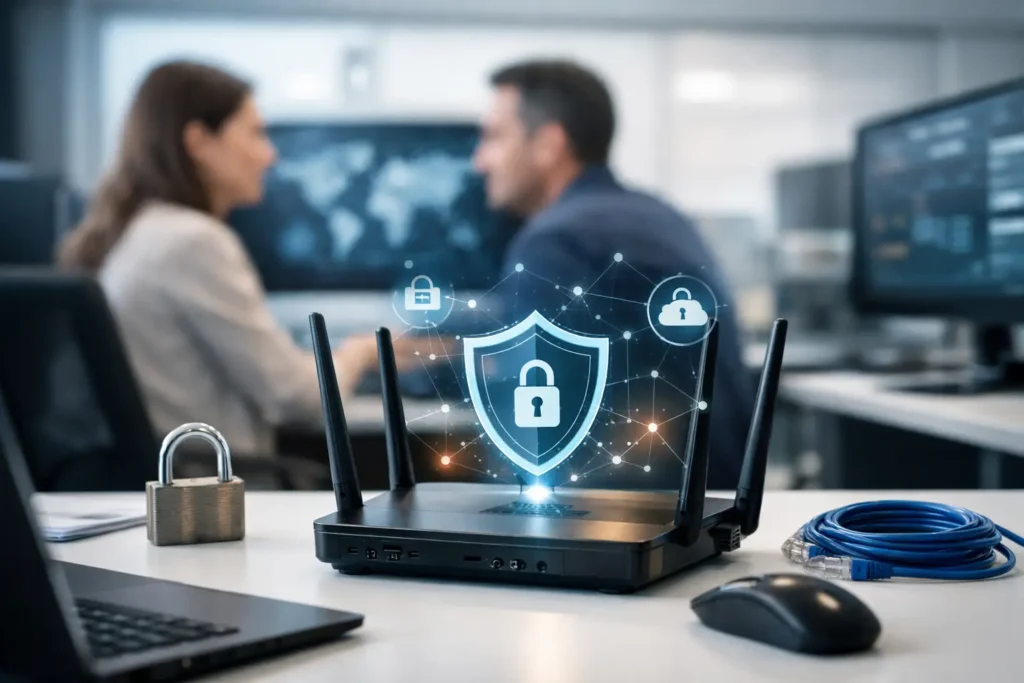
A ransomware email can arrive at 8:12 a.m. By 9:00, employees may be unable to access customer files, accounting systems, shared drives, or point-of-sale tools. The best office network security tools are not a collection of expensive products bought in isolation. They are connected layers that identify threats early, limit what an attacker can reach, and keep your business operating if something gets through.
For a Las Vegas office, retail location, warehouse, law firm, or home-office team, the right setup depends on the data you handle, the number of devices you manage, and how much downtime your operations can tolerate. A five-person professional office does not need the same security architecture as a multi-site business. It does need more than a basic internet router and antivirus installed years ago.
What the Best Office Network Security Tools Must Do
Security tools should support business continuity, not create more work for your staff. At a minimum, your security stack should protect the network edge, employee identities, email, computers and mobile devices, business data, and backups. It should also provide clear visibility when something unusual happens.
The trade-off is complexity. Adding too many disconnected tools can create gaps, duplicate costs, and leave alerts unread. Small businesses generally get better results from a focused set of managed tools with clear ownership, regular review, and documented response procedures.
The Best Office Network Security Tools to Prioritize
Next-generation firewall and secure network gateway
A business-grade firewall is the first major line of defense between your office network and the internet. Unlike a basic router, a next-generation firewall can inspect traffic, block known malicious connections, control which applications are allowed, and separate guest Wi-Fi from systems containing business data.
Firewall selection is not just about buying the device with the biggest specifications. A retail business may need secure segmentation between payment systems, employee devices, and guest wireless access. A law office may need tighter controls around remote access and file-sharing traffic. Multi-site companies often need secure site-to-site connectivity with centralized management.
The firewall must also be monitored and updated. An unmanaged firewall can become a false sense of security when its software, threat signatures, or rules are left unchanged for months.
Endpoint protection and endpoint detection and response
Every laptop, desktop, server, and supported mobile device is an endpoint. Employees work from home, use cloud applications, open attachments, and connect to wireless networks outside the office. That makes endpoint security essential, even when the office network itself is well protected.
Modern endpoint protection goes beyond traditional antivirus. Endpoint detection and response, often called EDR, watches for suspicious behaviors such as unauthorized encryption, unusual PowerShell activity, credential theft attempts, or a program trying to spread across shared folders. It can isolate a compromised computer before it affects the rest of the network.
EDR is especially valuable against ransomware, but it needs active management. A product that generates alerts without anyone reviewing them after hours will not provide the protection most businesses expect. For organizations without internal IT staff, 24/7 monitoring and a defined response process matter as much as the software itself.
Multi-factor authentication and identity protection
Passwords remain a common entry point for attackers. A strong password can still be stolen through a phishing page, reused from another breached account, or captured on an infected device. Multi-factor authentication, or MFA, requires a second form of verification before access is granted.
MFA should be enabled first for email, remote access, financial applications, cloud storage, administrative accounts, and any system that holds client or employee data. App-based authentication or hardware security keys are generally safer than text-message codes, though the right choice depends on employee needs and the systems in use.
Identity protection tools add another layer by detecting suspicious sign-in behavior. Examples include impossible travel alerts, repeated failed logins, sign-ins from unfamiliar locations, and attempts to change MFA settings. These tools are high value because one compromised email account can be used to send convincing fraud requests to coworkers and clients.
Email security and phishing protection
Email is still where many business attacks begin. A quality email security tool filters malicious attachments, impersonation attempts, dangerous links, and spam before they reach inboxes. It should also support domain protections that make it harder for criminals to spoof your business name.
No email filter catches every malicious message. Staff awareness remains part of the control. Short, practical training focused on invoice fraud, fake password-reset notices, QR-code scams, and unexpected payment changes gives employees a better chance of stopping an attack at the first click.
The most effective programs pair filtering with simple reporting. Employees should know exactly how to report a suspicious message and feel comfortable doing so. A quick question is far less costly than a wire transfer sent to a criminal or a compromised mailbox.
Secure DNS and web filtering
Secure DNS and web filtering prevent users from reaching known malicious websites, phishing domains, and inappropriate or high-risk categories. This layer can stop an attack even when a user clicks a bad link in an email, chat message, or online search result.
Web filtering also gives management practical control over internet use without turning the workplace into a surveillance project. Policies can block clearly dangerous destinations while allowing legitimate business research. The goal is reduced risk and fewer malware incidents, not unnecessary restrictions.
For remote employees, choose a tool that follows the device outside the office. Security should not disappear when a laptop leaves the building or connects through home Wi-Fi.
Network segmentation and secure Wi-Fi
Network segmentation divides your network into separate zones so that one compromised device cannot freely access everything else. Employee workstations, servers, point-of-sale systems, security cameras, guest Wi-Fi, and internet-connected equipment should not automatically share the same network.
This is one of the most overlooked office security tools because it is built into network design rather than installed on a single computer. Yet it can dramatically reduce the impact of malware. If a guest device or camera is compromised, proper segmentation can prevent that device from reaching financial records or shared business files.
Secure Wi-Fi requires more than a password on the wall. Use business-grade access points, encrypted wireless connections, separate guest access, current firmware, and a process for removing access when an employee or vendor no longer needs it.
Backup, recovery, and immutable data protection
Backups are a recovery tool, not a replacement for prevention. If ransomware encrypts files, a protected backup may be what keeps a difficult incident from becoming a business-ending outage. The best approach includes regular automated backups, encrypted storage, tested restoration procedures, and at least one backup copy that attackers cannot easily alter or delete.
A backup that has never been tested is an assumption. Businesses should periodically restore a sample of files and, when possible, a full system image to confirm recovery time and data integrity. Consider how long you can operate without your accounting platform, customer records, or shared documents. That answer should guide backup frequency and retention.
Security monitoring with SIEM and SOC support
Security information and event management, or SIEM, collects and correlates security events from tools such as firewalls, endpoints, cloud services, and identity platforms. A security operations center, or SOC, provides people and processes to investigate meaningful alerts.
For smaller businesses, SIEM and SOC services make sense when they are right-sized. A company handling regulated data, supporting remote staff, operating multiple locations, or facing elevated fraud risk may benefit from continuous monitoring. A very small office may begin with managed firewall, EDR, MFA, and backup, then add advanced monitoring as its risk and compliance needs grow.
How to Choose Tools Without Creating More Gaps
Start with a short risk assessment rather than a shopping list. Identify the systems that would hurt most to lose, where sensitive data lives, who has administrative access, how employees work remotely, and what recovery requirements your clients or regulators expect.
Then evaluate each security solution against four practical questions:
- Does it protect a real risk facing our business, or is it a feature we will never use?
- Who will configure it, update it, and respond when it creates an alert?
- Does it work with our existing computers, cloud services, Wi-Fi, and line-of-business software?
- Can we document its settings and show evidence of protection for insurance, client, or compliance requirements?
Cost matters, but the cheapest product is rarely the lowest-cost decision. A tool that is installed but never maintained can leave your business exposed while still adding a monthly expense. Predictable managed security plans often make more sense than trying to coordinate several vendors and hoping an employee notices an alert.
Build a Security Stack That Fits the Way You Work
There is no single best brand or single device for every office. The best office network security tools work together around your operations: a managed firewall protects the edge, segmented Wi-Fi limits exposure, EDR protects devices, MFA protects accounts, email and DNS tools reduce phishing risk, and tested backups protect recovery.
For businesses without an internal IT department, the missing piece is often accountability. Someone needs to review access, apply updates, test backups, document incidents, and answer when something goes wrong. System Integrators of Nevada provides that local, security-first support model so business owners can focus on serving clients rather than coordinating technology vendors.
A useful next step is to walk through one realistic scenario with your team: an employee receives a convincing phishing email, clicks the link, and enters a password. If you can clearly explain what blocks the threat, who gets notified, and how operations continue, your security tools are doing their real job.